


 |  |  |
|---|---|---|
 |
Research and Introduction
How did we come to be? The biological complexity of our modern
world is the product of a rich, yet intricate evolutionary history
that demands an interdisciplinary approach to unravel.
For this reason, our lab maintains a highly integrative research
program at the interface of the geological record of life and the
biological mechanisms driving its evolution with a focus on major
evolutionary transitions of vertebrate clades. We therefore combine
wet-lab based molecular techniques, bioinformatics,
and paleontological data to address not only the biological
phenomena shaping the extant biota, but also the
macroevolutionary patterns that produced them.
Specifically, we apply:
Specimen-based research of both extinct and modern species in a
phylogenetic context, allowing for robust evolutionary inferences
that inform both ‘recent’ and deep divergences in the tree of life.
Practical and theoretical integration of evolutionary-developmental biology to interrogate the mechanisms driving extant diversity and to formulate hypotheses as to the developmental mechanisms and their evolution that shaped it across deep time.
Quantitative comparative modelling at the macroevolutionary and developmental scale to link geological and biological events and the fundamental rules that shaped phenotype.
In integrating the above approaches, the lab provides a robust toolkit for the investigation of biological phenomena at a multitude of timescales and at every tier of biological complexity. Inquiry at this level permits the investigation of the most profound efforts driving contemporary evolutionary biology, including the endeavor to bridge the genotype-phenotype map and understanding the interplay of development and evolution.


Meet our team
I am an evolutionary biologist interested in disentangling the mechanisms underpinning changes of the vertebrate body plan across time and space.
I currently am an Assistant Professor at the Center for Functional Anatomy & Evolution, School of Medicine Johns Hopkins, and an Associate Faculty for the Department of Earth & Planetary Sciences at Johns Hopkins. I am also an Associate Researcher at the Field Museum of Natural History of Chicago and American Museum of Natural History in New York.
I obtained my Bsc at the Department of Geology, University of Florence. I then moved to a Msc in Paleobiology at the Department of Biology, University of Bristol. I finally obtained a MPhil and PhD at the Department of Earth & Planetary Sciences at Yale University. I conducted my Postdoctoral research in Chicago, as a recipient of the Negaunee Postdoctoral Fellowship at the Field Museum of Natural History and a Chicago Fellows Awardee at the Department of Organismal Integrative Biology, University of Chicago.
Classes I currently teach include Human Anatomy (ME.130.600.0001), Evolution & Development of Vertebrates (AS.270.310.01), and Methods and Theory in Evolutionary Functional Morphology (ME.130.754.0001).
Matteo Fabbri - Principal Investigator

Sergio M. Nebreda - Postdoctoral Researcher
Email: smart223@jh.edu
Research focus: During my PhD at the Universidad Autónoma de Madrid, I worked on the macroevolution and integration of the amniote skull, in addition to participating and leading numerous manuscripts regarding the dinosaur to bird transition based on remarkable fossils from Europe. I use quantitative comparative methods to illuminate the fundamental variables shaping the extinct and extant diversity of forms. I will be interrogating hypotheses of the vertebrate body plan integration across development and macroevolution from a molecular and quantitative perspective.
Keywords: Macroevolution, Amniota, Organismal Biology, Phenotypic Integration

Will Foster - Incoming Postdoctoral Researcher
Email: wfoster7@jhu.edu
Research Focus: I investigate the interaction of embryogenesis and the evolutionary process as they relate to the foundational dynamics driving vertebrate structural diversity. To do this, I synthesize morphogenetic and molecular data from extant taxa with deep-time insights inherent to paleontology, all within a phylogenetic framework informed by evolutionary theory. In this conceptual setting, I test hypotheses regarding the origin of evolutionary novelty amongst vertebrates, ranging from the highly derived turtle body plan to the weaponized chameleon tongue. My work in the Fabbri Lab focusses on the evo-devo origins of vertebrate craniofacial diversity, with particular emphasis on those structures deriving from the branchial arches.
Keywords: Evolutionary developmental biology, vertebrate morphogenesis, body plan origins, vertebrate paleontology & systematics, structural biology.

Nathanael Lee - PhD Candidate
Email: nlee100@jh.edu
Research: My research interests focus on how development and evolution intersect. I aim to connect developmental and molecular mechanisms with evolutionary change to uncover how modifications to conserved genetic pathways can generate evolutionary innovation in craniofacial systems among early vertebrates. My PhD project focuses on the molecular and morphogenetic patterning of the brain among early gnathostomes, namely chondrychtians, early actinopterygians, and teleosts.
Keywords: Evo-Devo, Evolutionary Biology

Matthew Ji - PhD Candidate (co-advised with Dr Bever)
email: lji16@jhmi.edu
Research: My research interests lie at the intersection of development, bioinformatics, and evolution. I am currently developing research that will examine the morphogenesis of key vertebrate innovations, using both experimental and pattern-based approaches. My hope is to conduct highly integrative studies that connect developmental mechanisms with macroevolutionary trends.
Keywords: Development/morphogenesis, Evolutionary origins of the vertebrate body plan, Omics

Hayley Glore - Master student
Email: hglore1@jh.edu
Research: craniofacial development of modern reptiles with a focus on the origin and evolution of cranial musculature
Previous Education: University of Illinois Urbana-Champaign

Mia Naranjo - Master student
Email: mnaranj9@jh.edu
Research: craniofacial development of modern reptiles with a focus on the origin and evolution of the auditory system
Previous Education: San Diego State University

Emily Shuck - Master student (co-advised with Dr Bever)
Email: eshuck1@jh.edu
Research: influence and alteration of physiological processes during development in chicken embryos
Previous Education: BS Biology, The Ohio State University, Columbus, OH

Isabelle Darling - Master student (co-advised with Dr Balanoff)
Email: isabellegracedarling@gmail.com
Research: characterization of gene expression of pleiotropic genes regulating craniofacial development across reptiles
Previous Education: Bates College, Lewiston, ME and Harvard Brain Tissue Research Center, Belmont, MA.

Zoe Chen - Undergraduate student
Email: zchen214@jh.edu
Education : Molecular & Cell Biology, Johns Hopkins University


Publications
* indicates Lab members
2026
-
Nebreda SM*, Chiappe LM, Navalón G, Terol JC, Serrano FJ, Buscalioni ÁD, and Marugán-Lobón J. (2026). An isolated skull from Las Hoyas (Early Cretaceous, Spain) informs the early evolution towards elongated rostra in enantiornithine birds (Aves, Ornithothoraces). Swiss Journal of Palaeontology, 145, 251-265.
-
Lyons S, Nebreda SM*, and Vizcaíno SF. (2026). Skull evolution in woodpeckers via articular innovation and allometric decoupling facilitates pecking performance. Journal of Anatomy.
-
Griffin CT, Bugos J, Poust AW, Morris ZS, Sombathy RS, D’Emic MD, O’Connor PM, Petermann H, Fabbri M, and Colleary C. (2026). A diminutive tyrannosaur lived alongside Tyrannosaurus rex. Science, 391(6782), pp.300-305.
2025
-
O’Connor J, Clark A, Kuo PC, Kiat Y, Fabbri M, Shinya A, Van Beek C, Lu J, Wang M, and Hu H. (2025). Chicago Archaeopteryx informs on the early evolution of the avian bauplan. Nature, 641(8065), 1201-1207.
-
Spear JK, Hoffman EA, Miyamae JA, Whalen CD, Arre AM, Chen-Kraus C, Corley MK, Fabbri M, Gauthier JA, Hanson M, and Leiss A. (2025). Deep-time history of primate behavior and ecology as revealed by ancestral state reconstructions. Journal of Mammalian Evolution, 32(2), p.21.
-
Haridy Y, Norris SC, Fabbri M, Nanglu K, Sharma N, Miller JF, Rivers M, La Riviere P, Vargas P, Ortega-Hernández J, and Shubin NH. (2025). The origin of vertebrate teeth and evolution of sensory exoskeletons. Nature, 642(8066), pp.119-124.
-
Bland J, Dutel H, Long JA, Fabbri M, Bevitt J, Trinajstic K, Panagiotopoulou O, and Clement AM. (2025). Comparison of diverse mandibular mechanics during biting in Devonian lungfishes. Iscience, 28(7).
-
Napoli JG, Fabbri M, Ruebenstahl AA, O’Connor JK, Bhullar BAS, and Norell MA. (2025). Reorganization of the theropod wrist preceded the origin of avian flight. Nature, 644(8077), pp.699-705.
-
Senevirathne G, Fernandopulle SC, Richard D, Baumgart SL, Christensen AL, Fabbri M, Höppner J, Jüppner H, Li P, Bothe V, Fröbisch N, and Capellini TD. (2025). The evolution of hominin bipedalism in two steps. Nature, 645(8082), pp.952-963.
-
Bronzati M, Watanabe A, Benson RBJ, Müller RT, Montefeltro FC, von Baczko MB, Bhullar BAS, Desojo JB, Ezcurra MD, Knoll F, Langer MC, Lautenschlager S, Stocker M, Turner AH, Werneburg I, Witmer L, Nesbitt SJ, and Fabbri M. (2025). Neuroanatomical convergence between pterosaurs and non-avian paravians in the evolution of flight. Current Biology, 35(24), 6191-6198.
2024
-
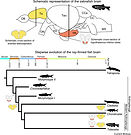
Fabbri M. (2024). Paleoneurology: Evolving an everted brain in actinopterygian fishes. Current Biology 34, no. 18: R862-R863.
-
Ballell A, Dutel H, Fabbri M, Martin-Silverstone E, Kersley A, Hammond CL, Herrel A, and Rayfield EJ (2024). Ecological drivers of jaw morphological evolution in lepidosaurs. Proceedings of the Royal Society B: Biological Sciences, 291(2036).


Facilities
Our Facilities include state-of-the-art molecular laboratory space which include set up for cell culture and organoids, micro-injector for experimental work spanning from retroviruses to CRISPR/Cas, automated thin sectioning equipment, and fluorescent microscopes. While our research spans across vertebrates, the Fabbri Lab houses a zebrafish colony at the Zebrafish Core Center, Johns Hopkins. High-end workstations are designed for processing, visualizing, and analyzing three-dimensional data (e.g., high-resolution computed tomography, synchrotron, confocal and light sheet data) with machine learning based software, as well as for computationally demanding quantitative methods, such as machine learning and AI algorithms.
Our Laboratory takes advantage of state-of-the-art imaging cores and cutting edge biological research centers housed at the Johns Hopkins Medical Institute for characterizing embryogenesis at the molecular, cellular, and system level. Among these are the Neuroscience Imaging Center, the Integrated Imaging Center, the Microscope Facility, the Johns Hopkins Whiting School of Engineering, the JH Genetic Resources Core Facilities, and the JH Genomics
Gallery


Join us!
We are constantly recruiting in our Lab
Undergraduate and Master students: the Fabbri Lab welcomes Undergraduate and Master students who are interested in gaining skills and research experience. If your interests include Organismal Biology, Evolution, and Development, feel free to contact Matteo Fabbri for more information and opportunities. No research experience is required.
Graduate students and Postdocs: our Lab is constantly looking for motivated, transformative, and ambitious students who are broadly interested in evolution and development. Our research program is dynamic and translational: do you have different expertise than the ones already present in the Lab? Excellent, we are keen in to expanding our questions and skill set! If interested, please contact Matteo Fabbri by email with an updated CV and a general idea of what you would like to pursue for your project.
Get in touch
Email: mfabbri1@jh.edu
Laboratory Adress:
Center for Functional Anatomy and Evolution
Johns Hopkins University School of Medicine
1830 East Monument Street, 3rd Floor
Baltimore, Maryland 21287 USA